CAD/CAM Dentistry — Computer-Designed, Precision-Milled Ceramic Restorations in Bangalore
As part of our fully integrated digital dentistry workflow, every crown, veneer, bridge, and inlay at Dental Solutions Clinic is designed and made using CAD/CAM technology rather than conventional impressions and hand built lab work. Your prepared teeth are captured in minutes with the Planmeca Primescan intraoral scanner, then digitally designed and precision milled from high quality e.max or zirconia ceramic blocks, producing restorations with consistently accurate fit, contact, and aesthetics that complement our CBCT, Digital Smile Design, and other digital systems.
CAD/CAM replaces a chain of analogue steps (impression material, stone models, wax patterns, casting/pressing) with a measurable, repeatable digital process. When the preparation is correct and the design is well executed, CAD/CAM crowns and veneers can achieve marginal gaps comfortably within accepted clinical limits, supporting better seals, less exposed cement, and potentially longer service life.
At Dental Solutions Clinic in Indiranagar, Bangalore, all prosthetic and cosmetic restorations follow this digital path, overseen by Prosthodontist Dr. Ramya Balasubramanya (MDS Prosthodontics, BDS Gold Medallist, Certified DSD Practitioner, Certified Invisalign Provider), with DSD integration for aesthetic work and CBCT data for implant supported cases.

What Is CAD/CAM Dentistry?
CAD/CAM stands for Computer Aided Design and Computer Aided Manufacturing. In dentistry, it refers to designing and fabricating restorations such as crowns, veneers, bridges, inlays, onlays, and implant prosthetics using 3D scans, design software, and milling units, rather than traditional impressions, stone models, and manual lab techniques.
The digital workflow has three main stages:
- A 3D intraoral scan records the prepared teeth and bite.
- CAD software is used to design the restoration so it fits the preparation and occludes correctly with opposing teeth.
- CAM milling machines carve the restoration from standardised ceramic blocks with known strength and optical properties, avoiding the shrinkage and variability of hand layered porcelain.
Restorations We Fabricate with CAD/CAM

Ceramic crowns (full coverage)
Used to restore heavily filled, fractured, or root canal treated teeth. Typically made from zirconia for high load back teeth or e.max for highly visible front teeth, and shaped directly from the intraoral scan for an accurate fit and contacts.

Porcelain veneers
Ultra thin e.max shells are bonded to the front of the teeth to refine colour, shape, and length. Designed using Digital Smile Design data so tooth proportions match the patient’s facial measurements before milling.
Ceramic inlays and onlays
Partial coverage restorations for back teeth where a filling is insufficient but a full crown would remove too much tooth. Designed digitally to replace only the damaged structure and maintain as much healthy tooth as possible.

Implant crowns
Screw retained or cement retained crowns are designed from scan bodies that record the exact position of the implant, allowing precise emergence profiles and occlusion over the implant platform.

Tooth supported fixed bridges
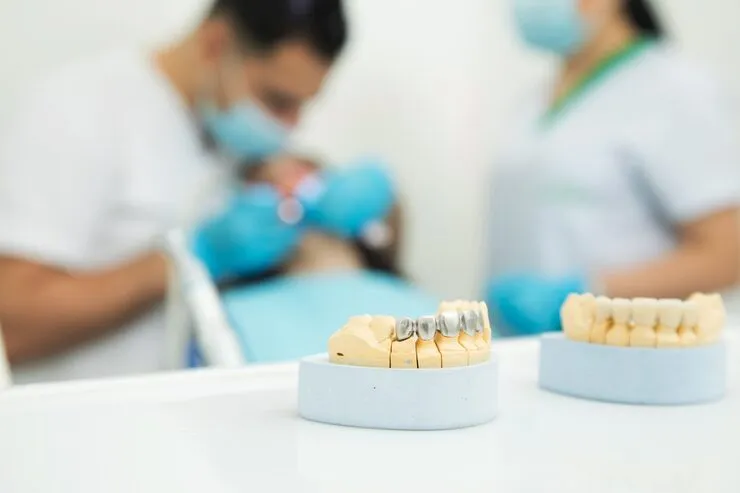
Multi unit bridges that use adjacent teeth as supports to replace missing teeth. The full arch scan captures abutments and edentulous spaces, and the pontic is designed to contour correctly to the gum ridge.
Implant supported bridges
Several implants connected by a single zirconia framework, designed to distribute load and maintain strength across the span while meeting aesthetic requirements in visible areas.
Provisional (temporary) crowns
Milled from PMMA using the same CAD design as the final restoration, providing accurate shape and bite during healing or trial phases.
The CAD/CAM Workflow at DSC — Step by Step

Tooth preparation
Teeth are prepared according to prosthodontic principles for the chosen material (minimal reduction for veneers, more for full crowns), with clear margins and appropriate taper to support retention, gum health, and aesthetics.

Digital impression (intraoral scan)
The Planmeca Primescan scanner captures the prepared teeth, adjacent structures, and opposing arch in a 3D scan without trays or impression material. The scan is checked immediately, and any missed areas are rescanned on the spot before the file is exported to design software.

CAD – restoration design
Using software such as Exocad, the restoration is designed on the scan model. The software suggests a starting morphology based on the surrounding teeth, which is refined for contacts, occlusion, and margin adaptation. For cosmetic cases, DSD data is imported so the design follows the approved smile plan.
CAM – precision milling
The final design file is sent to the milling unit, which reshapes the selected ceramic or PMMA block into the restoration. Milling times vary by material and complexity; after milling, e.max pieces are crystallised in a furnace and then stained and glazed to match the agreed shade and surface texture.
Try in and cementation
The restoration is tried to confirm fit, contacts, bite, and appearance in natural light. Necessary fine adjustments are made before bonding or cementation using the appropriate adhesive system. Final occlusion is checked and documented.
Why CAD/CAM Restorations Perform Well

Consistent marginal fit
Studies show that CAD/CAM crowns can routinely achieve marginal gaps in the tens of microns, often below commonly cited clinical thresholds. In contrast, conventional techniques show wider and more variable gaps.

Stable, uniform materials
Industrially manufactured ceramic blocks minimise porosity and inconsistencies found in hand layered porcelain, improving strength and durability when used correctly.

No analogue impression distortion
Digital scans avoid setting and deformation issues inherent to impression materials and stone models, reducing cumulative error across the workflow.

Reproducible designs
Each restoration’s design is stored as a digital file, so remakes or modifications can draw on the original CAD data without re scanning in many cases.

Integration with DSD and implants
For aesthetic veneers, DSD smile designs feed directly into the CAD stage; for implants, scan bodies and CBCT guided positioning allow restorations to be built in harmony with both bone and soft tissue.
In combination, these factors allow Dental Solutions Clinic to offer ceramic restorations that are precise, highly aesthetic where required, and planned within a fully digital, traceable workflow from scan to fit.
Frequently Asked Questions
What is the difference between a CAD/CAM crown and a conventional crown?
A conventional crown is made from a physical impression and a stone model, with the crown shape built by hand in the lab. A CAD/CAM crown is designed from a digital scan and milled from a ceramic block, eliminating several manual steps and delivering greater consistency and accuracy while fitting seamlessly into a digital workflow.
How long does a CAD/CAM crown take?
The digital scan is done at the preparation visit in a few minutes, then the lab designs, mills, and finishes the crown over about 5–10 working days for most cases. At the fit appointment, the crown is usually tried in, adjusted if needed, and cemented within 30–60 minutes.
Are CAD/CAM crowns and veneers as strong as conventional ones?
Yes, and in some cases stronger. Monolithic zirconia milled from dense blocks is highly resistant to chipping, and e.max crowns milled and crystallised from blocks achieve the same strength as pressed versions while offering more uniform material quality.
Can CAD/CAM be used for implant restorations?
Yes. A scan of the body on the implant is captured in the scan, allowing the software to locate the implant precisely in 3D so the crown can be designed with the correct emergence profile and angulation, especially useful for screw retained crowns.