
Pits & Fissures – Causes, Diagnosis and Treatment
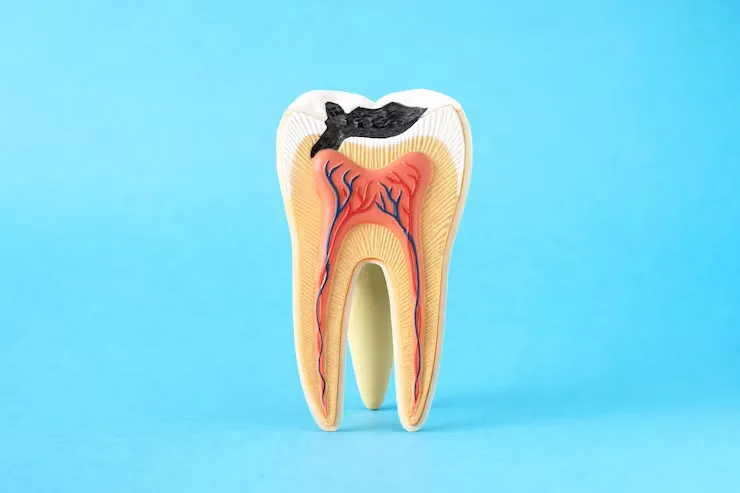
The chewing surface of a molar is full of tiny pits and grooves that can be 1–2 mm deep. Most children’s and teenagers’ cavities start in these pits and fissures because the grooves are too narrow for toothbrush bristles to reach, so plaque and bacteria stay trapped even when brushing is good.
Fissure sealants are thin, protective resin coatings placed over these grooves. They block food and bacteria from entering the fissures and are one of the most effective ways to prevent cavities in back teeth.
At Dental Solutions Clinic in Indiranagar, Bangalore, fissure sealant assessment and placement are a routine part of every child’s pediatric check‑up, carried out by Dr Ramya D S (MDS Prosthodontics, BDS Gold Medallist) as a key part of the clinic’s preventive care programme.

What Are Pits and Fissures?
- Pits are tiny depressions on the chewing surface of a tooth.
- Fissures are the narrow grooves that run between the cusps; they can be shallow or very deep and narrow, sometimes almost closed over at the top while extending far into the enamel.
The problem is their shape. Very narrow fissures can be thinner than a toothbrush bristle, so plaque and bacteria such as Streptococcus mutans can accumulate at the bottom where saliva, fluoride, and cleaning can’t reach, allowing decay to start and spread beneath the surface.
How Fissure Caries Develops?
- As soon as a new molar erupts, bacteria quickly colonise the deep fissures.
- Sugars from food and drinks enter these grooves and are broken down by bacteria into acids.
- Acid dissolves enamel from the bottom of the fissure upwards, spreading sideways under the surface.
- On the outside, you may see only a stain or a chalky white line while a larger hidden cavity is forming underneath.
- By the time a visible hole appears, the decay often already extends into dentine and is much bigger than it looks.
- If untreated, decay can reach the nerve, eventually requiring root canal treatment in a tooth that could have been protected by a sealant applied soon after eruption.

Causes and Risk Factors
Deep, narrow fissure shapes
Some children naturally have very deep, tight grooves that are hard to clean and are three times more likely to develop decay than shallow fissures. These shapes can’t be changed, only sealed.

Newly erupted molars
The first two years after a molar erupts are the highest‑risk period because the enamel is still maturing and the tooth is harder for children to clean properly. This is also the ideal window for placing sealants.

Frequent sugar intake
Regular snacks or sugary drinks between meals give bacteria a constant supply of sugar, leading to repeated acid attacks at the base of fissures.

Limited brushing skill
Children between about 6 and 12 often lack the dexterity and consistency to clean their new molars thoroughly, even with supervision, so plaque often remains in deep grooves.
Previous cavities
Children who have already had decay in baby teeth are at higher risk of fissure caries in their permanent molars and benefit most from sealants.
Sealants are preventive, not a treatment for existing decay. Sealing over active decay without cleaning and confirming that the fissure is sound can trap bacteria and worsen the problem; at DSC, DIAGNOdent laser caries detection is used to confirm that fissures are clean before sealing.
How We Assess Fissures at Dental Solution Clinic

- Visual and tactile check – We examine the colour, shine, and feel of fissures under magnification.
- DIAGNOdent laser caries detection – A laser device measures fluorescence from bacterial by products to distinguish sound fissures from those with early hidden decay.
- Digital bitewing X rays – Used if we suspect decay has spread beyond enamel into dentine.
- Eruption timing review – We identify newly erupted molars in the high risk 0–2 year window to plan sealant placement at the ideal time.
Treatment Choices – Sealants, Laser, and Small Restorations

Resin fissure sealants (for sound grooves)
A clear or tooth-coloured resin is flowed into clean fissures and set with a light, usually without drilling or injections. The seal completely blocks bacteria and food from entering and can reduce the risk of molar cavity by about 70–80% over several years.

At DSC, the Fotona LightWalker laser can be used to gently clean and decontaminate deep pits and fissures before sealant placement, especially in anxious children or where access is difficult. The laser helps remove plaque and early soft debris without a conventional drill, improving sealant bonding and making the procedure quieter and more comfortable.

Preventive resin restorations (for very early fissure decay)
If early decay is present but still shallow, only the softened enamel is removed (often with minimal drilling and, where suitable, laser assistance); the area is cleaned, and composite filling material is placed and extended into nearby fissures to seal them simultaneously.

Conventional fillings or inlays (for deeper decay)
When decay has already reached dentine, a normal composite filling or ceramic inlay is needed. In these teeth, the chance to prevent the cavity with sealants has passed, so treatment focuses on removing decay while keeping as much healthy tooth as possible.
Frequently Asked Questions
At what age should fissure sealants be placed?
Sealants work best when placed soon after the permanent molars erupt. The first permanent molars usually appear around ages 6–7, and the second molars around 12–13, so these are the key times to assess and place sealants; premolars are considered individually based on how deep their grooves are.
How long do fissure sealants last?
Well-placed resin sealants on properly isolated teeth can provide protection for many years, with studies showing that most are still present, in part or fully, at 5 years, and some last up to 10 years or more. Because worn or partially lost sealants can create new plaque traps, they are checked at every recall visit and topped up or replaced if needed.
Are fissure sealants only for children?
They are mainly used for newly erupted permanent molars in children and teens, where the evidence for benefit is strongest. However, adults with deep, caries-free fissures and a high overall risk of decay can also benefit from sealants, and suitability is determined on a case-by-case basis.
Do sealants contain BPA?
Some resin sealants can release very small, short-lived amounts of bisphenol A (BPA) as a breakdown product. Still, the levels measured in saliva are far below established safety limits and fall rapidly after placement. The proven benefit of preventing molar cavities in children greatly outweighs this theoretical risk, and BPA‑free sealant options are available at DSC on request.
My child already has a cavity in the fissure. Is it too late for a sealant?
That particular fissure now needs a filling rather than a simple sealant, but it is not too late to protect other sound molars or premolars. In fact, a cavity in one fissure confirms that your child is at higher risk overall, so sealing all remaining clean fissures becomes even more important.