
Implantology — Expert CBCT-Guided Dental Implant Planning & Placement in Bangalore
A dental implant is more than just a tooth replacement. It uniquely preserves bone, supports facial structure, and becomes a permanent part of your body. When positioned correctly with sufficient bone and by a skilled clinician using proper diagnostic tools, a dental implant can last a lifetime.
At Dental Solutions Clinic in Indiranagar, Bangalore, Dr. Ramya Balasubramanya, a specialist Prosthodontist and Implantologist, oversees implant assessment, planning, and surgical placement. She holds a BDS Gold Medal from RGUHS University, is a Certified Digital Smile Design (DSD) Practitioner, and a Certified Invisalign Provider. Each implant case is carefully planned using 3D CBCT imaging before any treatment decisions are made.
Have you been told you lack sufficient bone for implants? Have you been given a quotation without a CBCT scan? We recommend seeking a second opinion. Bone augmentation methods have improved greatly, and the outlook for implants in augmented areas is very positive when performed by an experienced implantologist.

What Is Implantology?
Implantology is a dental speciality focused on surgically placing, maintaining, and managing dental implants, which are titanium fixtures inserted into the jawbone to substitute missing tooth roots. After they osseointegrate, meaning they fuse with the bone over 3–6 months, a dental crown, dental bridge, dentures or full-arch prosthesis is attached, restoring both function and appearance to closely mimic natural teeth.
Implantology Conditions We Treat

Single Tooth Loss
A missing tooth leads to a localised bone defect that worsens over time if left untreated. The optimal solution is a single implant with a custom crown, which preserves the bone and function without impacting surrounding healthy teeth.

Multiple Missing Teeth
Two to four missing teeth can be replaced with individual implants or an implant-supported bridge, depending on bone availability and the span involved.

Fully Edentulous Arch
Patients who have lost all teeth in one or both arches have two primary implant-supported options: an overdenture retained by 2–4 implants (removable), or a fixed full-arch bridge supported by 4–6 implants (All-on-4 or All-on-6). The fixed option is closest to natural dentition in function, stability, and patient satisfaction.
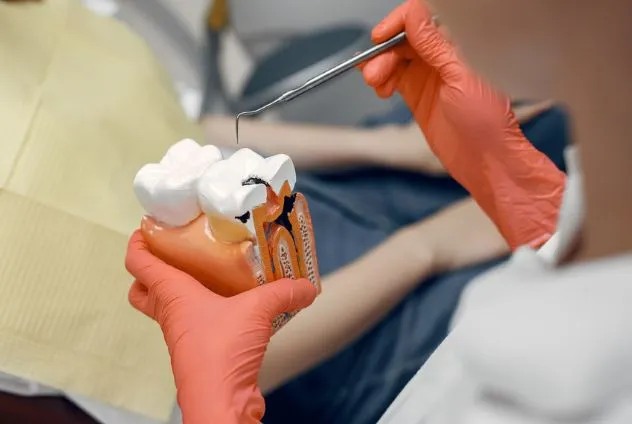
Failed or Failing Implants (Peri-Implantitis)
Implants can develop peri-implantitis, an inflammatory condition that affects the surrounding bone, similar to periodontitis around natural teeth. Treating it involves early detection, mechanical and laser cleaning, and, in severe cases, bone regenerative procedures.
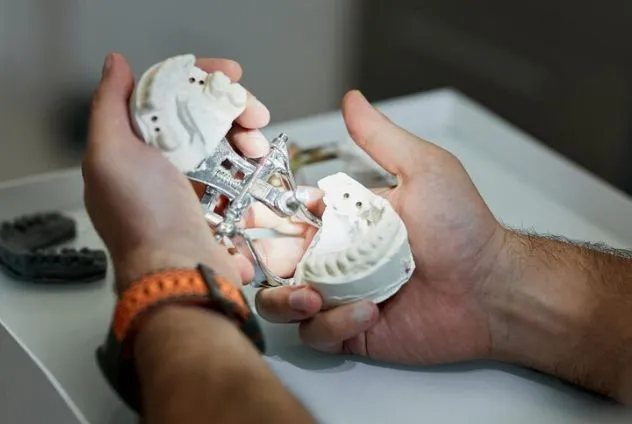
Implants in Patients with Insufficient Bone
Bone loss resulting from extraction, periodontal disease, or prolonged denture use often results in inadequate bone volume for immediate implant placement. To address this, bone augmentation procedures such as socket preservation, guided bone regeneration, ridge splitting, or sinus lifts are typically performed initially to reconstruct the implant site.
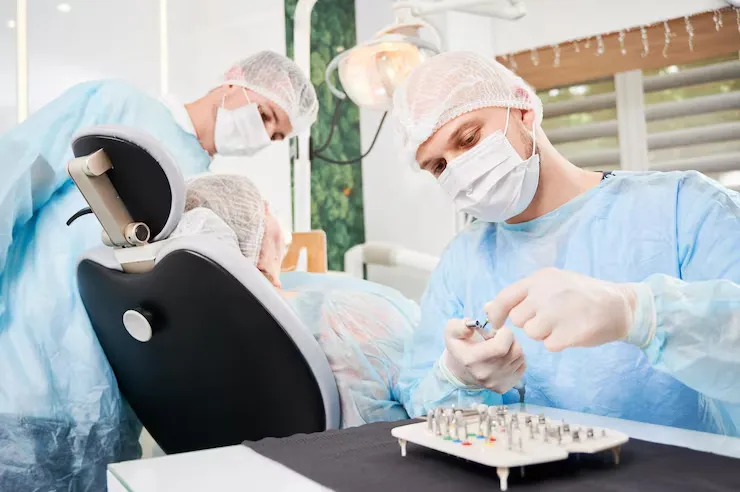
Implants in Medically Complex Patients
Patients with Type 2 Diabetes, osteoporosis, a history of bisphosphonate use, or on anticoagulants need thorough pre-operative evaluation and customised treatment protocols. Implant placement in diabetic patients is feasible and reliable when HbA1c is well-controlled.
Our Implantology Treatments

CBCT Assessment and Implant Treatment Planning
Every implant case begins with a three-dimensional bone assessment using the PLANMECA ProMax CBCT scanner, which provides precise measurements of bone width, height, and density, maps nerve and sinus positions, and enables virtual implant placement before the first incision.

Single Implant Placement
A titanium implant fixture is placed into prepared bone under local anaesthesia. The procedure takes approximately 45–90 minutes. The implant osseointegrates over 3–6 months before the final crown is fitted.

Bone Augmentation — Guided Bone Regeneration (GBR)
Where bone volume is insufficient, bone substitute material and a resorbable or non-resorbable membrane are used to regenerate the deficient site. GBR can be performed simultaneously with implant placement or as a staged procedure 4–6 months before implant surgery.

Sinus Floor Elevation
Two techniques are used: the lateral window approach for cases with less than 4mm of residual bone, and the transcrestal approach using the Densah bur system for cases with 5–7mm of residual bone. The latter is minimally invasive and allows simultaneous implant placement in most cases.

Full Arch Implant Rehabilitation
Full arch cases are planned using CBCT data, digital smile design, and a detailed prosthetic wax-up. The All-on-4 or All-on-6 configuration provides stable, permanent dentition. A provisional fixed bridge is placed at the time of surgery; the definitive prosthesis follows after osseointegration.

Implant Maintenance Programme
Implants require professional maintenance at 3–6 month intervals. Peri-implant tissues are probed, radiographic bone levels are monitored, and the implant surface is professionally decontaminated. Early detection of peri-implantitis is the most effective way to protect a long-term investment in implants.
Technology We Use —Why It Matters
Cosmetic treatment at Dental Solutions Clinic is supported by a fully digital workflow to improve precision, predictability, and comfort:
PLANMECA ProMax CBCT
Three-dimensional bone mapping for every implant case
Fotona LightWalker Er: YAG + Nd: YAG Dual-Laser:
Laser decontamination and soft tissue surgery
Densah bur system
Crestal sinus lift technique for posterior maxillary implants
CAD/CAM digital workflow
Intraoral scanning with Planmeca Primescan for implant crowns and bridges
Piezoelectric surgical unit
For atraumatic bone preparation in sinus lifts and ridge expansion

Meet Your Treating Specialist
Dr. Ramya Balasubramanya
Prosthodontist & Implantologist | Co-Director, Dental Solutions Clinic
- MDS (Prosthodontics), BDS Gold Medallist — RGUHS University Topper
- Diploma & Master’s in Laser Dentistry — SOLA, University of Vienna, Austria
- Certified Digital Smile Design (DSD) Practitioner
- Certified Invisalign Provider
- Karnataka State Dental Council — Registered Specialist
- Member: IDA, Indian Prosthodontic Society (IPS)
- Professor & Senior Consultant — Prosthodontics, Sakra World Hospital, Bangalore
- 25+ years of specialist practice
Frequently Asked Questions
Am I a candidate for dental implants if I have bone loss from gum disease?
In many cases, yes — but gum disease must be fully treated and stable before implants can be placed. Having active periodontitis during implant placement is the biggest risk for early failure. Once the disease is controlled, bone augmentation can restore deficient areas, allowing implants to be placed in the regenerated bone with high success.
How long does the whole implant process take?
For a simple single implant in sufficient bone, the entire process from placement to the final crown usually takes about 3–6 months. If bone grafting is necessary beforehand, this period extends by an additional 4–6 months. Full arch cases are generally completed within 6–12 months.
How long do dental implants last?
In patients with good oral hygiene and regular professional care, dental implants can last a lifetime. However, the crown or prosthesis may need replacement after 15–20 years due to wear. The main risk factor for losing an implant is peri-implantitis, a condition that can be prevented through consistent maintenance.
I have diabetes. Can I still get dental implants?
Yes, in most cases. When diabetes is well-managed with an HbA1c below 7.5–8%, implant success rates are similar to those of non-diabetic patients. We will request your latest HbA1c result during the consultation.
What is the difference between an All-on-4 and an All-on-6?
Both treatments involve full-arch fixed implant restorations. All-on-4 employs four implants per arch, while All-on-6 uses six. When sufficient bone is available, All-on-6 helps distribute occlusal forces more evenly. All-on-4 utilises angled implants to maximise anterior bone support when the posterior ridge is lacking. Your CBCT scan will guide the choice of the best configuration.